Showing posts with label aviation. Show all posts

Monday, December 9, 2013

Breaking Records and Barriers: Amelia Earhart

Earhart portrait printed in
the Syracuse American on
December 6 1936.
Courtesy of  Fulton History
Amelia Earhart was a national celebrity, galvanizing support in a similar way that race car drivers do today.  The public watched intently as she set world records, broke down barriers and challenged social conventions both in the air and on the ground.  She also excelled outside of the cockpit; she co-founded National Airways (later known as North-East Airlines); penned several books; and became a notable orator; according to Mary Lovell, Earhart delivered a total of 136 speeches and lectures in 1936 alone. 
The Herald Statesman
reports on Earhart's
flight to Newark on
May 8, 1935

Courtesy of Fulton 
History

Earhart was a frequent user of New York airports, although her years of flying preceded both LaGuardia and JFK.  Rather, Newark was her regional airport of choice, which is unsurprising given that it was the first and only commercial airport in the area at the time.  However, she would also later fly into the Floyd Bennett Airfield and practice at the Glenn H Curtiss, which LaGuardia replaced in 1939. 

Earhart and her accomplishments were constantly the focus of media attention, and understandably so.  A poll conducted by NYU journalism students in 1935 cited Eleanor Roosevelt and Amelia Earhart as the best-known women in the world; a finding that makes sense given that Earhart’s name was featured in the papers on an almost weekly basis.  Not only was Earhart one of the few female pilots in the industry, but she was also able to compete with her male counterparts – often setting records for both genders.  

In 1935 Earhart set the record for the first solo flight (male or female) direct from Mexico City to Newark, which she completed in just over 14 hours.  Although nowadays a fourteen-hour flight from Mexico City to Newark might set the record for most inefficient flight ever, it was seriously fast for the time.  New Yorkers were delighted by the feat, so much so that between 10 and 15 thousand spectators crowded the airport in celebration of her arrival.  The happy crowd picked up Earhart outside her plane and carried her on their shoulders to the official reception committee.  However, not everyone was thrilled by the public show of enthusiasm; her husband referred to the greeting as “the most disgraceful scene that I have ever witnessed,” (although we’re inclined to believe that it wasn't). 
Earhart was greeted with similar enthusiasm after her 1932 arrival in Newark. Photo: Citizen Advertiser June 24 1932. Courtesy of Fulton History.
The press was fascinated by her marriage, frequently reporting on the messages sent between Earhart and her husband, George “GP” Putnam, during her lengthy journeys.  On one occasion, the Brooklyn Daily Eagle published an article entitled, “Amelia’s husband knew ‘She’d do it’” in reference to her 1937 flight to Honolulu from Oakland.  This was the first leg of her round-the-world flight, which she completed in 15 hours and 47 minutes – a world record.  Putnam claimed, “I knew she’d make it easily,” (although the reporter did note that GP had stayed up nearly all night in order to receive messages from her plane.)  Furthermore, Earhart made the controversial decision to retain her maiden name once married, a decision which was flagrantly disregarded by the New York Times, who opted to refer to her as Mrs. Putnam.  In fairness, her husband was often referred to as Mr. Earhart, so safe to say it wasn't personal. 


Click the "i" button in the top right-hand corner for the details of each of the pictures.  

Thursday, November 21, 2013

LaGuardia's most "marvelous and enlightening sight"...

Was its air traffic control technology!

Back when airplanes were only just starting to take off and airports were a place to visit rather than a dreaded purgatory, air traffic control technology was cool.  People were excited by the gears and gadgets that made flight possible and New York Mayor Fiorello LaGuardia ensured that New York Municipal Airport, as it was then known, had the state-of-the-art equipment. 

For example, the Duke of Windsor, who visited Flushing in 1939 to see both the airport and the World’s Fair, thought the most “marvelous and enlightening sight” was in fact the airport’s control tower.[1]  The tower was positioned on top of the Central Terminal Building (CTB) and had sixteen radio receivers which could pick up calls on any airline frequency.  This technological innovation meant the dawning of a new age and the people of New York knew it (as did the Duke of Windsor). 

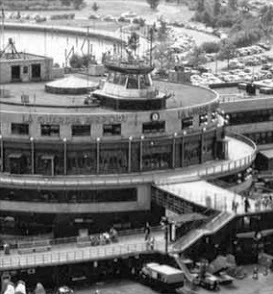
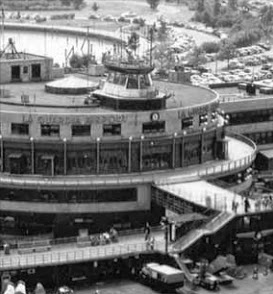
LaGuardia's air traffic control center was located on top of the CTB, as seen in this picture.  Photo: Port Authority of NY & NJ
The new air traffic control tower, erected in 1964, was another exciting technological advancement, albeit controversial, as it was thought to resemble an ice cream cone or Swiss cheese, depending on who you ask.  The structure was designed by local heavy-weight Wallace K. Harrison, who was also responsible for the 1939 World’s Fair’s Trylon and Perisphere as well as several other monumental New York City buildings.  But the new structure was also exciting because of what it stood for – LaGuardia Airport staying ahead of the curve. 
LaGuardia's first air traffic control tower.  Photo: Port Authority of NY & NJ
However, exciting developments are underway that would help greatly enhance airline travel but they need the public's help and involvement.  NextGen, the name given to the US’s GPS air traffic technology due to replace the old radar system, would drastically cut delays caused by plane stacking and poor weather conditions, and enable pilots to fly more direct and efficient routes.  All in all, it’s not only a safer option, but it would also save everyone masses of time in the airport and on the runway. 

LaGuardia's new state-of-the-art air traffic control tower replaced the infamous ice cream cone tower in 2011.  Photo courtesy of International Airport Review
It’s not rocket science and yet the technology is lacking a public awareness necessary to turn it into a reality.  It’s in everyone’s interest to upgrade but unless we acknowledge that, change will be slow and low on the list of priorities.  So, if you ever spend time in an airport or on a plane, spread the word – it’s time to get excited about NextGen.   

For more information about NextGen, watch this video:


[1] Alistair Gordon, Naked Airport: A Cultural History of the World’s Most Revolutionary Structure (Chicago: University of Chicago Press, 2008), 116.  

Thursday, November 14, 2013

Opening Up, Part III

New York City’s First Commercial Airport

Newark Airport, formally known as Newark Metropolitan Airport, opened long before both JFK and LaGuardia on October 1, 1928.  It operated for a time as the region’s only commercial airport, located a mere fourteen miles from Manhattan.  Before Newark, there was Heller Field, a US Mail Airfield located in the North Ward, which lasted only a short while; from December 1919 to May 1921.  Hadley Field soon replaced Heller Field in 1923 as the post office needed an air base.  However, the four airlines using Hadley ultimately made the transition to Newark Airport and the field was shut. 

Mail workers unload the mail bags from the well in the front part of the fuselage. Photo: Newark Evening News, December 8, 1919, courtesy of Newark Public Library
Plans to build the airport were announced on August 3, 1927 and the city moved with great haste in order to ensure the airport attracted the air mail business, whose existing contracts were due to expire in 1928.  Sure enough, the city’s efforts paid off and on February 18, 1929, the airport officially opened as an Eastern terminal for the United States air mail.  According to an article published in the Brooklyn Daily Eagle the following day, more than 25,000 people showed up to witness the event, which was marked by the takeoff of three planes, each of which departed at separate times while carrying mail.  In addition, the new airport had welcomed its first international passengers on October 17, 1928, who flew in from Montreal on a Canadian Colonial Airways Ford Tri-Motor. 

Etching of Newark Airport by George A. Bradshaw for the Journal of Finance and Industry in 1929.  Photo: Newark Public Library
However, that is not say that construction of the airport was simple; far from it!  The airport was located on swampland and so had to be raised by six feet and four miles of creeks had to be diverted.  To fill the ground, the city used dry fill which consisted of 7,000 Christmas trees and 200 safes donated

Perhaps the only commercial NYC airport created outside the influence of Fiorello LaGuardia, Newark was championed by Newark Mayor Thomas Lynch Raymond.  Unfortunately, however, like LaGuardia in the case of JFK Airport, Raymond did not live to see the fruits of his labor, dying days before the grand opening.  

Newark had the world's first paved runway. Photo: Port Authority of NY & NJ, 1928, courtesy of Newark Public Library
Noting the absurdity of the lengths the city was going to in order to build the airport, one reporter urged his readers to, “Forget the airport!  The craze for aviation will soon die out!”[1]  That reporter, however, could not have been more wrong; not only was aviation to become massively popular, but it is estimated that roughly 50,000 people went to visit the airport every Sunday throughout the 1930s. 

Newark's original Art Deco Administration Building, which served as a terminal building until the opening of North Terminal in 1953. Photo: Port Authority of NY & NJ
Newark also paved the way for airports all over the world – it was reputedly the first airport in the world to have a paved runway.  It was also the first airport in the US to build a terminal building.  The opening of what is now Newark’s Administration Building in 1935 was therefore a significant event.  Amelia Earhart, the famed aviatrix, formally dedicated it.  Newark became the world’s busiest airport, with 90,177 passengers in 1931 alone. Furthermore, Earhart was a frequent visitor of the airport and was one of the many celebrities often seen flying in and out.  

In September 1930, passengers on the new Newark-Washington plane lined up to have their photo taken at Newark Airport.  Left to right: J.V. MacGee, former Vice President of Transcontinental Air Transport; A.W. Gilliam, Washington newspaper representative; Amelia Earhart, Vice President of the line; Mrs. Mabel Walker Wllebrandt, former Assistant United States Attorney General; Major General J.E. Fechet, Chief of the United States Army Air Corps; Command J.Q. Walton of the Coast Guard; Sydney Gross of Washington. Photo: Newark Public Library


[1] Geoffrey Arend, Great Airports: Newark International (Air Cargo News Books, 1989), 27.  

Thursday, November 7, 2013

Opening Up, Part II

The Excitement of an Airport Opening: John F. Kennedy Airport

Kennedy Airport opened nearly a decade after its predecessor, LaGuardia, and yet New Yorkers were just as thrilled as they had been in 1939.  JFK was only renamed a month after the assassination of said President.  Prior to that, the airport was officially called New York International Airport (not New York Airport because it sounded far too similar to Newark Airport).  However, it was mostly known as Idlewild Airport after the golf course it replaced. 


Aerial Shot of Idlewild Airfield. Photo: pdxretro.com
Located a mere fifteen miles from Times Square, New York International Airport was dedicated on July 31, 1948 and the city put on quite the production.  Crowds flooded in from all over to partake in the day's excitement just as they had done for North Beach.  According to an article in the Brooklyn Eagle, not only were 200,000 people in attendance, but celebrities showed up as well.  

The day consisted of a number of festivities but followed a highly regimented schedule – everything was planned down to the very minute.  As part of the celebrations, 900 tactical airplanes partook in a flyover, which would have been a remarkable show and delighted the many who were watching. 

Planes could be seen taking off overhead in celebration of the day, as published in this New York Times article from August 1, 1948. Photo: New York Times
In addition, not only was the mayor of the time, William O’Dwyer, present for the event, but President Harry S. Truman also attended, which indicates just how important an airport opening was, especially for a nation still in recovery from the Second World War.  It was within this context that President Truman issued a desperate plea for international peace.  The speech was aired on a nationwide broadcast, so the event provided him with an excellent platform with which to disseminate his views to a wider audience. 


Truman "pleading for world unity" at the ceremony as published in the Brooklyn Eagle on August 1, 1948.
Photo: fultonhistory.com
Truman issued his remarks at 2:30 in the afternoon from a stand in the middle of the airfield. During his speech, Truman also noted some of the benefits of air travel:  

Planes will land here, bringing newspapers printed only a few hours earlier in Rome, or Paris, or London. Papers printed in the morning in New York will be on the streets of European cities that night.[1]

Although New York had had North Beach Airport (LaGuardia) for several years already, locals were still adjusting to the notion of air travel, which had yet to become the standard practice that it is today.  Most of the subsidiary benefits of flight, such as instantaneous international news coverage, were still novel concepts! 

President Harry S. Truman shakes hands with NYC Mayor William O'Dwyer at the dedication of Idlewild Airport on July 31, 1948.  Photo: trumanlibrary.org
The President also highlighted the importance of the trade and commerce that the airport would stimulate.  Although, little did he know that JFK would later become the biggest and busiest air cargo airport in the region!  The other chief speaker was Howard S. Cullman, the Chairman of the Port of New York Authority, as it was then known.  

President Harry S. Truman (fourth left) stands with NY Gov. Thomas E. Dewey, a former rival Presidential candidate (far right), for the dedication of Idlewild Airport on July 31, 1948.  Photo: pdxretro.com
JFK has continued to grow and thrive over the years and although sixty-five years on we may take our almost instant access to international news for granted, we certainly continue to appreciate a good airport because even nowadays, there’s nothing quite like it!


[1] Harry S. Truman, “Remarks in New York City at the Dedication of Idlewild International Airport,” in the Public Papers of the Presidents: Harry S. Truman, 1945-1953, accessed November 3, 2013, http://www.trumanlibrary.org/publicpapers/index.php?pid=1769.  

Thursday, October 24, 2013

Observing Change

The Observation Deck Phenomenon

When airports first opened in the US, flying was glamorous.  Locals flocked to the airports to witness the miracle of flight, and with less stringent security, just about anyone could show up and do just that.  Thus, the observation deck became a staple of the twentieth-century airport, and airports were as much an attraction as they were a transit zone. 

According to a New York Times article, back when JFK airport was still known as Idlewild and photos were still taken in black and white, roughly 3,500 youngsters would gather each week to watch the take off and landings from this elevated vantage point.  


Spectators line up along JFK's observation deck on Nov. 21, 1948. Photo: The New York Times
However, the viewing platform at LaGuardia was perhaps even more popular, especially given that it opened nearly a decade before that of JFK.  North Beach Airport, as LaGuardia was often referred to, opened in 1939, making it one of New York City’s first commercial airports and quite the novelty.  

View of LaGuardia's popular observation deck, known as the SkyWalk. (Photo: Port Authority of NY & NJ)
Airport officials installed turnstiles and charged each visitor a ¢5 entry fee to enter its SkyWalk, turning the deck into a source of profit.  Furthermore, this viewing platform was also equipped with a stand selling drinks and refreshments to visitors, known as SkyBar.  So as you can probably imagine, this outdoor area turned into quite the social scene attracting many a New Yorker.  


A lady places an order at LaGuardia's SkyBar, located on its SkyWalk. Photo: The Port Authority of NY & NJ
Although it developed as a commercial airport later, Newark Liberty was also home to an observation deck, where spectators were welcome to sit and watch the action taking place on the runways before them.  This viewing station ran for 500 feet along the mezzanine deck in the old North Terminal.  


The Observation Deck at Newark's old North Terminal located above the ticket booths. Photo: Aviation Hall of Fame of New Jersey
Unlike the decks at the other airports, this one was not outside in the open-air.  However, the gallery was unique in that it was located above the ticket booths and as such, provided visitors with an elevated, sprawling view of the airport and its runways.  

The Observation Deck at Newark Airport. Photo: The Pie Shops Collection
Over time, however, the air of mystery surrounding air travel began to wear off and these observation decks saw fewer visitors.  People were no longer interested in standing around and watching planes.  So as the terminal buildings began to develop, the once-popular observation deck did not and they were ultimately shutdown as the phenomenon faded into obscurity and security concerns grew.   So while that may have worked back then, this kind of airport access was not going to survive the test of time on a practical level.


However, that is not to say that our airports are giving up entirely on providing passengers with some of the excitement and glamour associated with visiting observation decks in the 40s, 50s and 60s.  New York City’s airports modernization efforts appear to have these themes in mind, trying to maintain some of the old spirit while providing services that will appeal to the modern traveler.  For example, Delta installed its first open-air terrace at JFK this year.  It is a far cry from the LaGuardia’s old SkyBar, but a lot of travelers may prefer it.  This intimate setting has a comfortable seating area and a place to order drinks so that Delta’s frequent fliers can kick back in style while waiting in the airport.  This observation deck-revival harks back to this golden age when flying was exotic, suggesting that perhaps airports are still a place where people can enjoy themselves.  We hope it’s a sign that outdoor areas are making a comeback at NYC airports!

Delta's recently opened an outdoor seating area in their SkyLounge at JFK's Terminal 4. Photo: Chris Sloan for Airchive


Keep an eye out for our next post!