Showing posts with label JFK Airport. Show all posts

Friday, February 7, 2014

Beatlemania: The airport landing that started it all

50 years ago, on February 7, 1964, three nervous but excited Liverpudlians landed at one of the most famous airports in the world.  And although the Beatles would become world famous too, they had yet to make a name for themselves outside of Great Britain. 


Beatles land at JFK. Photo courtesy: ringofstars.ru
They flew in on PanAm flight 101 from London and touched down at JFK at 1:20 pm. It was their first ever time in the US and it did not disappoint.  They were greeted by thousands of screaming girls and a flurry of reporters. 

Girls lined up on the observation deck desperately vying for the attention of the Englishmen. Photo courtesy: ringofstars.ru
Many girls, so excited by the presence of these British Rock N Rollers, were reduced to tears and some even fainted -- the emotion was palpable.
 

Crowds went mental for the newcomers. Photo courtesy: ringofstars.ru
After posing for photos on the tarmac, they took questions from the press in the PanAm terminal in what would be one of their most famous press conferences. Their back and forth between the reporters was sharp and witty. 

Asked at one point their thoughts on Beethoven, Ringo Starr answered, “Great, especially his poems.”


Beatles, quipping with reporters, at their first U.S. Press Conference. Photo courtesy: ringofstars.ru
Their funny accents, mop-top haircuts and popular tunes took America by storm, resulting in widespread Beatlemania -- which is somewhat akin to Bieber Fever from the looks of it.  According to Capitol, they had the fastest selling album in history.  

All in, it was a landmark arrival for the Beatles as well as the rest of the nation. They went on to perform on The Ed Sullivan Show, which was, in true Beatles style, a smashing success.  

This article accurately captures the tone of the airport reception as "delirious". Photo courtesy: rarenewspapers.com
Fans from all over the world poured into JFK today to celebrate the anniversary, although they didn’t quite match the gusto of that first reception in 1964.  The Port Authority hosted the event at the renovated TWA Flight Center with a musical performance from Beatles tribute band, Liverpool.  All in, sounds like a great way to celebrate the day. 

Thursday, January 30, 2014

Top 10 Visitors Guide to New York City's Airports

With the Super Bowl just days away, hundreds of thousands of visitors are expected to drop in on the New York-New Jersey region.  The first and last part of most fans’ trip will take place in one of our region’s three major airports: JFK, LaGuardia or Newark. 

Even though these airports have often ended up at the bottom of passenger surveys, there are still great things for Super Bowl guests to see and do while traveling through our airports, which are conveniently connected to the City via cost-efficient transportation links.

So in the tradition of NYC’s own “Late Night with David Letterman,” GGA presents our “Top Ten” visitors guide to NY-NJ Area Airports:

10. Get Real Time Airport Alerts and Advisories – Signing up for these handheld updates will make sure you don’t miss a thing when it comes to your flight.  The service, provided by the Port Authority, messages you in the event of general disruptions to airport operations, which may prove to be particularly helpful given the weather we’ve been having.   And the good news is: it’s free.  

9. Convenient Pick Ups from the JFK Cell Phone Wait Lot –The Cell Phone Wait Lot at JFK eliminates the stress and the cost of an airport pick up.  Cars can wait for free for up to an hour in a nearby parking lot until getting the call or text from passengers ready to be collected.

JFK Cell Phone Lot.  Photo: Ken Spencer, Courtesy of greatvisualtruths.blogspot.com
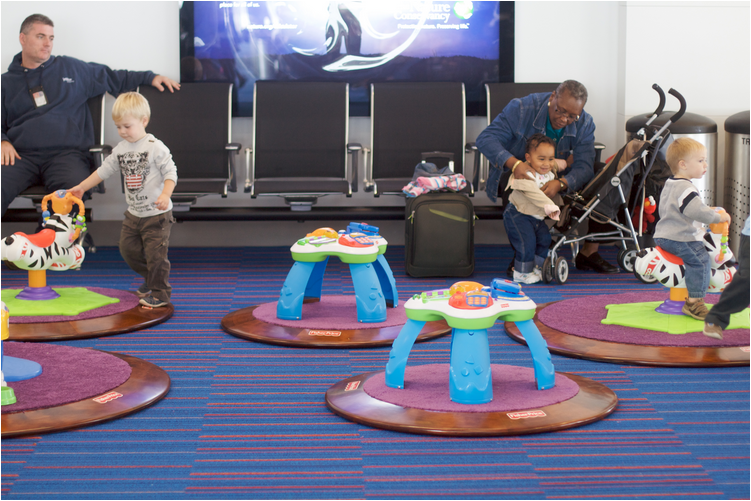
8. Have the kids blow off steam at the Play Area at JetBlue Terminal 5 – Airports can be a challenge for parents traveling with young children, especially if you’re stuck there for a while.  But not at the JetBlue Terminal at JFK, which has become a popular destination.  Here, kids have the chance to play and explore in a safe environment, while you get the chance to sit down and relax (if only a short while, anyway). 

The play area at JetBlue's JFK Terminal. Photo credit: JetBlue's Flickr
7. Try Some Fine Dining – New York is famous for fine food, and our airports are becoming a foodie haven as well.  For example, stop by the Grand Central Terminal Oyster Bar in Newark’s Terminal C, featured on CNN’s “Best Eats at Busiest U.S. Airports” list.  This is not only delicious but, as an offshoot of the Grand Central-based restaurant, it makes for an authentic New York experience.  There are also award winning establishments at LaGuardia, like Crust and Taste of Tagliare.  Terminal 5 also features everything from hole in the wall bistros to sushi bars.  Basically, don’t get on the plane on empty stomach! 

Grand Central Oyster Bar at Newark Airport. Photo: Spence Cooper, Courtesy of blog.friendseat.com
6. Shop the latest gadgets, books and gear – The redeveloped terminals at JFK, LaGuardia and Newark all feature state-of-the-art retail post-security.  InMotion Entertainment in Newark’s Terminal C is stocked with the latest in electronics, not to mention key flight accessories, such as chargers and neck pillows.  Meanwhile, at LaGuardia, Delta’s recent upgrades to Terminal D gives passengers access to free iPads attached to desks, an amenity which serves both a useful and fun purpose.  Equally, Terminal 4 at JFK was recently redone, meaning that all the trendiest brands have opened up shop, from Ferragamo to Puma and Swarovski.  Inspired by food trucks, Benefit Cosmetics has also launched their Glam Up & Away kiosks in JFK’s Terminals 2 and 5, so you can grab your makeup on the go! 


Benefit Cosmetic's Glam Up & Away Airport kiosk. Photo credit: www.moodiereport.com
5. Watch the Planes from the Food Court Observation Deck – The dining spot at Terminal 1 in JFK is an ideal place to kick back and watch the planes fly in and out.  With spacious glass windows, the food court functions as an observation deck but means you don’t have to venture outside to get the best view in the house. 

Food court in Terminal 1 at JFK. Photo credit: stuckattheairport.com
4. Get to/from the airport on the AirTrain – This overground train is one of the “cooler” modes of transport available to and from the airport.  With its raised tracks and streamlined cars, if you haven’t ridden it already, you should.  For families with train-enthusiasts on board this is a must.  But “cool-factor” aside, it is one of the most efficient ways to get into the city, so forget cabs and take the AirTrain at either JFK or Newark and make an easy connection directly to Midtown Manhattan. 


Top: JFK AirTrain; Bottom: Newark Airtrain. Photo credit: Port Authority of NY and NJ
3. Grab a Burger at ShakeShack – NYC is the birthplace of this famed burger chain but if you don’t have time to squeeze it in during your visit, fear not.  One such joint has opened in Delta’s Terminal 4 at JFK, which means many passengers have now boycotted plane food in favor of a burger and fries.  It’s so popular, in fact, that Moodie rated it the Best Fast Food/Quick Service Restaurant in October 2013. 

ShakeShack at Terminal 4. Photo credit: airchive.com
2. Keep your device juiced at the Power Poles – We’ve all faced that scary moment when your device is running perilously low, with nowhere to charge it.  But at JFK, LaGuardia and Newark, you won’t have a problem.  Samsung’s Power Poles provide passengers with charging stations throughout all three airports, meaning you can crack open your electric devices, do what you have to do and not worry about running down the battery.   

Power Pole in LaGuardia's CTB. Photo credit: Port Authority of NY and NJ
1. Visit NYC!  – The best part of our airports is that each is just a short trip to NYC. From museums to markets, bowling alleys to movie theaters, and bars to cafes, there are near endless things to do.  Fun as the airports may be, nothing beats the City they serve. 


NYC Skyline. Photo: Buck Ennis, Courtesy of Crain's New York
So there you have it.  These are our 10 best for grabbing a bite, catching a ride, or just hanging out.  We’re crossing our fingers for good weather and minimal delays, but whether Super Bowl visitors are in NY-NJ area airports for a short time or longer than they hoped for this week, there’s plenty to do.  

Thursday, January 23, 2014

The 'Airport City': Outdated or Futuristic?

Back in the 60s NYC airports led the way in luxury and comfort...

Fifty years ago, New York’s airports were the height of fashion, luxury and technology.  In fact LaGuardia was voted ‘the greatest airport in the world’ in 1960 by the worldwide aviation community.  The airports typified the notion of the Golden Age of Flying. 

JFK Airport. Photo credit: Port Authority of New York and New Jersey
Time Magazine published an article in 1960 which referred to New York International Airport at Idlewild (JFK) as ‘the most glittering airport showcase.’  The article, entitled “Airport Cities: Gateways to the Jet Age,” discussed the growing demand for aerotropolises – new urban spaces located on airport property which supplied travelers with a full range of services and amenities, including hotels, bars and restaurants.   

Fifty years later, Time Magazine has completely reversed the position of our airports.  Writing once again on the subject of airport cities, New York’s JFK is described as ‘hopelessly lost in the past.’[1] 

JFK Terminal 4. Photo credit: wikipedia.com
While the Golden Age of Flying may have ended, the airport city is not a thing of the past.  Other cities are attracting both business and leisure travelers by providing resort-like facilities to accommodate their visitors in a Golden Age Revival of sorts.  

Manchester, a growing metropolis in North West England, is a prime example.  The British Government has welcomed Chinese investment in the hopes that a new and improved airport will attract both domestic and foreign business.  The investment will take the form of hotels, offices, manufacturing firms, logistics and warehouses among other amenities.

Manchester Airport. Photo credit: macdonaldandcompany.com
Although the investment structure may be somewhat unusual, airport development is not.  In fact, some global airports have gone even further to ensure that the passenger experience is the best it can be.  For example, Incheon International Airport in South Korea is home to an ice rink, a movie theater, and a casino as well as six themed gardens among other exotic and entertaining facilities.[2] 

The ice rink, known at the Ice Forest, at Incheon International Airport. Photo credit: airport.kr
In order to remain a competitive global player, New York must endeavor to create a more hospitable airport environment.  It’s time to raise the bar and set the standard and for New York area airports to foster the same excitement and opportunity that they were once known for.   

Thursday, December 12, 2013

“The Train to the Plane” that Never Really Took Off


Cast your mind back to a time before the AirTrain, a time when smoking was still allowed on planes and you had to call to book your ticket because the internet wasn't invented yet.  Well, back then, passengers traveling to and from the airport might have opted to take the JFK Express subway train, a route not too dissimilar from the ones passengers use today.  The service ran from the Queensboro Bridge at 21st Street in Queens, through Manhattan, all the way to the Howard Beach Station, also in Queens.  While in Manhattan, the train ran on the B line and once it hit the last stop on the island, West 4th Street – Washington Square, it ran non-stop.  From there, riders took a bus to JFK Airport.  Aside from their lack of graffiti, this new line also differed from its 1970s counterparts in that the fares were collected by conductors on-board and all cars were fully air-conditioned, making it the shiny, new line. 

This map shows the route followed by the JFK Express, which originated in Queens, ran through Manhattan and then circled back through Queens before reaching the Howard-Beach station.  
This express service, thought to be “the pride of the subwaysystem” when it opened on September 23, 1978, was expected to revolutionize the city-airport commute by providing the necessary link between the two.[1]  A series of commercials aired on TV to advertise the new airport line, which is where it received its famous nickname, The Train to the Plane.  However, the success of the Express was short-lived; it was ultimately cancelled on April 15, 1990, a mere twelve years after it opened, which begs the question: what went wrong?   


The primary reason for discontinuing the subway line was low ridership.  According to the Metropolitan Transit Authority (MTA), by the time the service was coming to a close, only 3,200 people were using it as opposed to the 4,000 to 5,000 when it first opened.[2]  Furthermore, transit officials also claimed that a majority of passengers were commuters rather than people trying to get to and from the airport, meaning that overwhelmingly few were paying the full airport fare and greatly reducing the cost-effectiveness of the project. 

An original JFK Express ticket. Photo courtesy of thejoekorner.com
Indeed, this decline in usage was indicative of the line’s decline in popularity.  But what was the underlying cause?  The JFK Express was not really true to its name in that it wasn't an express to the airport.  It was not "the Train to the Plane" per se.  Rather, it was a subway service that got passengers pretty close to the airport, but in the end it was a bus that delivered you to the terminal.  As a two-leg journey, it was less appealing to airport commuters, the second leg a deal breaker for many due to the fuss of having to transfer and the risk of delays at both points. 

This is a 1987 subway map, showing the JFK Express route (the light blue line). This map predates the addition of the Queensboro stop, which was added two years later.   
However, not everyone was pleased to hear the news of the route closure – the Port Authority spoke out in opposition as, in their opinion, the line provided a crucial link between the airport and the city, one that enabled passengers to travel easily between the two.  Furthermore, the split between the Port and the MTA ran deeper; while the Transit Authority reasoned that the Port had not done or invested enough in airport links, the Port suggested that a viable transport route was the responsibility of the state, city and local transit agencies.  In other words, they both claimed the other was responsible. 

The JFK Express logo on some of the original carriages. Photo courtesy of Wikipedia
But thirteen years and 1.9 billion dollars later, it was the Port who took the next step by building an additional airport transit link, known as the AirTrain.  However, this too was created within the same Port Authority-MTA dichotomy that divided them over the JFK Express – the AirTrain runs only as far as Jamaica Station, at which point passengers to leave the Air Train station and walk 200 feet to the subway or the Long Island Railroad (LIRR).  As such, we can’t help but feel that the AirTrain never really addressed the main issue facing airport commuters and the one that resulted in the failure it predecessor, the JFK Express.  It is a problem only really resolved by a one-seat ride. 

JFK's AirTrain connects all JFK terminals with airport facilities and local rail stations.  Photo courtesy of PANYNJ
That said, all is not lost and the AirTrain may still provide the solution.  While LIRR trains may fit on AirTrain tracks, differences in weight and voltage prevent them from sharing the rails.  However, as Capital New York pointed out today, the hybrid train would be able to straddle the two.[3]  This new train would consist of four-car trains, 240 feet in length and have a maximum capacity of 236 people per train, and, most importantly, it would pick up passengers at Penn Station and deposit them directly at their terminal. 

Here’s to hoping for a 2014 that includes progress on a real “Train to the Plane” for NYC area airports.  


[1] David E. Pitt, “Transit Agency Wants to End Airport Express,” New York Times, October 22, 1989. 
[3] Dana Rubenstein, “The One-Seat Ride to J.F.K.? Possible.,”  Capital New York, December 12, 2013.  

Thursday, November 7, 2013

Opening Up, Part II

The Excitement of an Airport Opening: John F. Kennedy Airport

Kennedy Airport opened nearly a decade after its predecessor, LaGuardia, and yet New Yorkers were just as thrilled as they had been in 1939.  JFK was only renamed a month after the assassination of said President.  Prior to that, the airport was officially called New York International Airport (not New York Airport because it sounded far too similar to Newark Airport).  However, it was mostly known as Idlewild Airport after the golf course it replaced. 


Aerial Shot of Idlewild Airfield. Photo: pdxretro.com
Located a mere fifteen miles from Times Square, New York International Airport was dedicated on July 31, 1948 and the city put on quite the production.  Crowds flooded in from all over to partake in the day's excitement just as they had done for North Beach.  According to an article in the Brooklyn Eagle, not only were 200,000 people in attendance, but celebrities showed up as well.  

The day consisted of a number of festivities but followed a highly regimented schedule – everything was planned down to the very minute.  As part of the celebrations, 900 tactical airplanes partook in a flyover, which would have been a remarkable show and delighted the many who were watching. 

Planes could be seen taking off overhead in celebration of the day, as published in this New York Times article from August 1, 1948. Photo: New York Times
In addition, not only was the mayor of the time, William O’Dwyer, present for the event, but President Harry S. Truman also attended, which indicates just how important an airport opening was, especially for a nation still in recovery from the Second World War.  It was within this context that President Truman issued a desperate plea for international peace.  The speech was aired on a nationwide broadcast, so the event provided him with an excellent platform with which to disseminate his views to a wider audience. 


Truman "pleading for world unity" at the ceremony as published in the Brooklyn Eagle on August 1, 1948.
Photo: fultonhistory.com
Truman issued his remarks at 2:30 in the afternoon from a stand in the middle of the airfield. During his speech, Truman also noted some of the benefits of air travel:  

Planes will land here, bringing newspapers printed only a few hours earlier in Rome, or Paris, or London. Papers printed in the morning in New York will be on the streets of European cities that night.[1]

Although New York had had North Beach Airport (LaGuardia) for several years already, locals were still adjusting to the notion of air travel, which had yet to become the standard practice that it is today.  Most of the subsidiary benefits of flight, such as instantaneous international news coverage, were still novel concepts! 

President Harry S. Truman shakes hands with NYC Mayor William O'Dwyer at the dedication of Idlewild Airport on July 31, 1948.  Photo: trumanlibrary.org
The President also highlighted the importance of the trade and commerce that the airport would stimulate.  Although, little did he know that JFK would later become the biggest and busiest air cargo airport in the region!  The other chief speaker was Howard S. Cullman, the Chairman of the Port of New York Authority, as it was then known.  

President Harry S. Truman (fourth left) stands with NY Gov. Thomas E. Dewey, a former rival Presidential candidate (far right), for the dedication of Idlewild Airport on July 31, 1948.  Photo: pdxretro.com
JFK has continued to grow and thrive over the years and although sixty-five years on we may take our almost instant access to international news for granted, we certainly continue to appreciate a good airport because even nowadays, there’s nothing quite like it!


[1] Harry S. Truman, “Remarks in New York City at the Dedication of Idlewild International Airport,” in the Public Papers of the Presidents: Harry S. Truman, 1945-1953, accessed November 3, 2013, http://www.trumanlibrary.org/publicpapers/index.php?pid=1769.