Showing posts with label airports. Show all posts

Monday, July 7, 2014

RACE TO LAGUARDIA

Last Monday at 2:45 p.m. on a sunny afternoon, seven airport enthusiasts embarked upon a grueling journey – a journey that took them from New York City to LaGuardia’s Central Terminal Building (CTB). 

GGA interns and Steve race to LaGuardia using different modes of  transportation
Each participant went via a different route and mode of transport, ranging from subways and buses to Uber and taxis, as well as a lone Citibike.  

While the average travel time was 48 minutes and the cost $15, the routes ranged from 25 minutes to over an hour, and costs varied from as high as $44 to a low of $2.50. (See end of post for full breakdown of results.)

Read about each of their experiences to decide which mode you’ll opt for next time you’re faced with a trip to LaGuardia. 

1. Fiona
Mode: Taxi
Time: 25 mins
Cost: $33

I took a standard NYC yellow taxi from 39th Street and 6th Avenue to LaGuardia Airport. I expected the trip to have moderate traffic, but was also counting on an easy journey to LaGuardia. It was relatively easy to hail a cab at 2:45 PM taking around two minutes and 40 seconds.
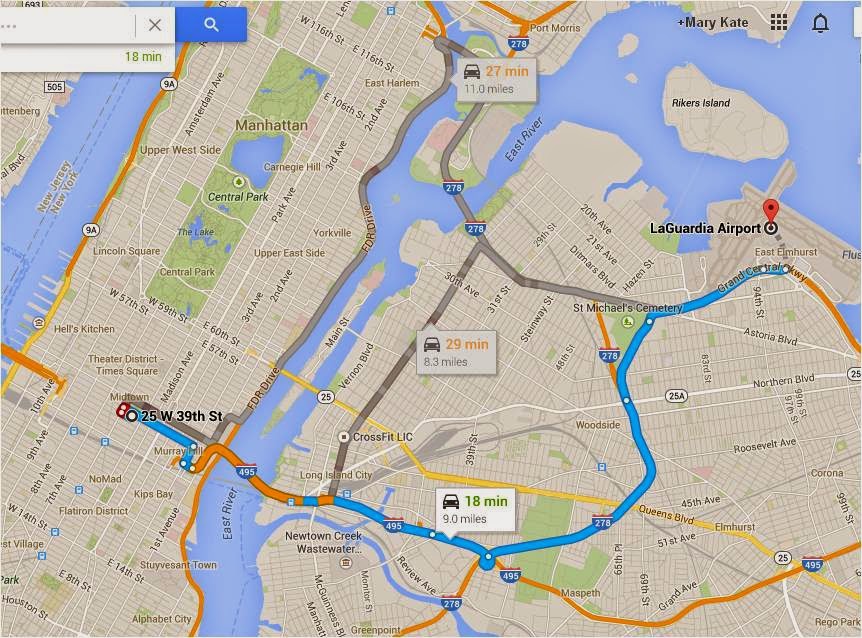
Driving directions from Midtown to LaGuardia
Once in the cab, the trip was simple. There was very little traffic along the way, making it fast and easy. The driver took the Queens Midtown tunnel where there was very little congestion. Once out of Manhattan we barely stopped until we arrived at LGA.

In total it took me 25 minutes to get to Terminal B at LGA. I was the first to arrive and waited 19 minutes for the next person (Alex taking the NYC Airporter shuttle) to make it there.


Overall it was a very simple and stress-free travel experience. The taxi cost $33.00 (20% tip included). The NYC yellow taxi exceeded my expectations by getting me to LaGuardia in such a timely manner.


2. Alex
Mode: NYC Airporter
Time: 44 mins
Cost: $13


I took the NYC Airporter from Grand Central Station all the way to LaGuardia. I originally thought I would be waiting at least 15 minutes at Grand Central just to get on a packed bus. I have a poor sense of direction, so from the GGA office on 39th Street it took me about 15 minutes to find the bus stop at Grand Central.

Luckily, I arrived in time to catch one of the last seats on the 3:00 PM bus, which actually departed at 3:03 PM. For some reason there was no air conditioning on the 36 passenger bus, so at least half of the passengers were fanning themselves the whole way. 

The ride was pleasant except for the lack of air conditioning and the simplicity of the logistics of my route made the ride relaxing. The driver was friendly and had a good sense of humor, which I appreciated. I arrived at Terminal B at 3:29 PM, stepped out, and saw the driver scrambling to help people with their luggage.


In my opinion, the NYC Airporter is a cheap option ($13.00 one-way) for the low maintenance traveler. Thanks to good timing, the shuttle was more efficient than I expected. However, the hot temperatures made the journey less than enjoyable.


3. Caroline
Mode: UberX
Time: 48 mins
Cost: $44


I took an UberX car from W 39th Street between 5th and 6th to LaGuardia. The race started at 2:45 PM and a colleague called the Uber for me. From past experience, I expected Uber to be the fastest and most convenient way of traveling.

The app said that the car was 5 minutes away and we should be on the lookout for a Ford Explorer. However, over 5 minutes passed and the car was still not there, and after a failed attempt to call the driver, the ride clean disappeared from her app.

So, we called another UberX. Again, this car said it was 5 minutes away. We watched the tracker and saw that the car passed 39th and went down 38th St., at which point we decided to call the driver. As it turned out, our location was off – telling the driver we were on 38th instead.  Unfortunately this technical glitch cost us. 

After 23 minutes of waiting, the Uber Lincoln Town Car finally came and I was on my way to LaGuardia Airport Terminal B. The route took me through the Queens Midtown Tunnel and enjoyed a smooth ride. I arrived at departures area at the Central Terminal Building at 3:33 PM. There was no traffic and the car ride in total took 25 minutes.


Once the Uber car had arrived, the route was no problem. The only issue was trying to contact the car. I recommend making sure that your current location is correct.


4. Steve
Mode: CitiBike
Time: 49 mins
Cost: $2.50
Bicycle route from GGA office to LaGuardia

I started the ride outside GGA’s office at 39th street between 5th and 6th. It was a slightly hairy ride up 6th avenue with traffic to 48thstreet. 48th Street to 1st Avenue had a good bike lane although it was very tight with cars and trucks.

I turned up 1st Avenue, which has a wide bike lane to the Queensboro Bridge. There were lots of trucks in the bike route but they could be maneuvered around.  

The long half mile climb up the bridge was the toughest hill of the journey, although it had very nice bike/walking lanes and great views of Roosevelt Island and up the East River.  Then it was downhill to Queens Plaza, through a lot of traffic on the bike path over another bridge to Skillman Avenue.  A police car there had stopped two cars, which made for some maneuvering around to 43rd Avenue.  

It was about 3 when I entered the Queens surface streets portion of the ride. There was a nice bike route up 43rd Avenue, but it was a hot slog for a mile.

I turned onto 48th Street down to 39th Avenue through very pretty and shady residential areas for another mile.  The biggest obstacle on that portion were lots of red lights, but thankfully they were mostly one way streets with little traffic at that hour, so stopping was , uh, optional.

I took a right onto 34th Street, which also had a nice bike route, at about 3:15-3:20. It was a hot, crowded push for a mile and a half. A police cruiser that saw me pedal through a red light stayed with me for a few blocks and made sure I stopped at the lights! 


I counted down (or up) the streets to Junction Boulevard and took a crowded left around 3:25, turning for the hot sprint the last 1.5 miles up it and 94th Street.

I crossed some major streets as fast as I could maneuver through traffic. I passed a weird art installation on 94th Street, saw the American Airlines hanger in the distance and pedaled hard to the airport grounds and to Terminal B. 


Riding a bike to LaGuardia was more pleasant and well-marked than I had expected.  It’s not a practical option unless you’re taking a day trip, but it sure beats sitting in traffic. 


5. Mary Kate
Mode: 7 train to Q70 bus
Time: 56 mins
Cost: $2.50
My route to LaGuardia Airport involved a subway and bus combination that Google Maps estimated to take 47 minutes. However, my total travel time amounted to 55:30. This extensive commute leads me to question why there isn’t a simpler, more efficient route to get travelers from Midtown to LaGuardia, a trip that is just 8 miles long.

My experience on the 7 train was fairly enjoyable. I didn’t have to wait long at the subway platform, and once the train came, I was able to find a seat and read my book in peace. I only saw one other person headed towards the airport, lugging a huge orange suitcase that probably would have annoyed me if we were in a crowded subway car. I arrived at my interim stop (61ststreet and Woodside) in just 17 minutes, and exited the train in search of the Q70 bus station to start the second leg of my journey.

There were signs highlighting my destination, with arrows pointing towards a desolate bus stop situated underneath the elevated subway tracks. Though the bus was already there waiting for me, the driver would not let me on for six minutes while she took a short break to make a phone call. To my surprise, the Q70 was less crowded than the 7 train, with few riders bearing luggage, duffel bags, or any indication they were headed to the airport.

Instead, the passengers got off at different stops along the route, using it to navigate the neighborhoods of northern Queens.  The bus ride took me to the final destination—LaGuardia Airport’s Central Terminal Building.

It was a quick walk to the terminal where I met up with the rest of the group. I finished the race in 5th place, arriving at at 3:41 PM. The one seat routes—shuttle bus, via taxi, Uber, and CitiBike—proved faster than those that required transfers.


6. Will T.
Mode: LIRR to Q70 bus
Time: 56 mins
Cost: $8.25
I took a train from Penn Station to the Q70 bus from 61st Street and Roosevelt Avenue in Queens. I expected this method of transportation to be confusing and inconvenient, but I also knew it would be cheap.

I left the GGA office at 2:45 PM and began walking to Penn Station. At a fast paced walk, it took me 14 minutes to arrive. Unfamiliar with the Long Island Railroad, I needed to be directed to the train I was looking for. The LIRR representative working at the ticket station directed me to the 3:03 PM train on Track 18.

I purchased a rail ticket costing $5.75, and a Metro Card for the bus costing $2.75. There was not much seating available on the train due to my last minute arrival, but it was only a 16 minute ride to Woodside, where I would meet the bus.

I got off the train and followed the signs to the Q70 bus. I waited for four minutes for the bus, which departed at 3:24. The bus ride went smoothly, and was fairly comfortable. It arrived at Lot L at 3:41, which is the stop for the Central Terminal Building.

Actually reaching the terminal, however, proved to be a little confusing due to a lack of signage directing the passengers on how best to get there. However, I reached my fellow travelers shortly thereafter.


Overall, the trip cost $8.25 and took a total of 56 minutes. The LIRR and Q70 met my expectations of being a long and inconvenient journey, however, the bus was much cleaner than I expected.


7. Will S.
Mode: 4 train to M60 SBS
Time: 61 mins
Cost: $2.50

I started my journey at GGA’s offices on 25 W 39th St. in Midtown and made the 4 block walk to Grand Central Terminal. I walked into the station and found the 4 train uptown. By the time I had arrived at the subway stop, I was 11 minutes into my trip.

I got on the 4 train and noticed no one with bags or luggage making the same trip as me. 3 stops later I ended up at the Harlem 125th subway stop and headed for the M60 bus stop. From when I got on the train to when I arrived in Harlem, 11 minutes had passed. I walked up the stairs and found the bus stop where the M60 was supposed to pick me up. I swiped my metro pass and received a receipt that worked as a ticket for me to enter the bus.

29 minutes later, in a bus filled with some travelers carrying luggage, I arrived at the departures area at the LaGuardia Central Terminal Building and met up with the rest of my group.


Sadly, I was the last one to arrive and in total it took me about an hour to make the whole trip. In conclusion taking the 4/5 subway uptown to Harlem 125th followed by the M60 is not the fastest way to get to LaGuardia Airport.  


Steve and the interns arrive at LaGuardia!


Rank
Participant
Mode
Travel Time
Start Time
Finish Time
Transfers
Cost
1
Fiona
Taxi
25mins
2:45 p.m.
3:10 p.m.
0
$33
2
Alex
NYC Airporter
44mins
2:45 p.m.
3:29 p.m.
0
$13
3
Caroline
UberX
48mins
2:45 p.m.
3:33 p.m.
0
$44
3
Steve
CitiBike
49mins
2:45 p.m.
3:34 p.m.
0
$2.50
5
Mary Kate
7 train to Q70 bus
56mins
2:45 p.m.
3:41 p.m.
1
$2.50
6
Will T
LIRR to Q70 bus
56mins
2:45 p.m.
3:41 p.m.
1
$8.25
7
Will S
4 train to M60 SBS
61mins
2:45 p.m.
3:46 p.m.
1
$2.50


Thursday, January 23, 2014

The 'Airport City': Outdated or Futuristic?

Back in the 60s NYC airports led the way in luxury and comfort...

Fifty years ago, New York’s airports were the height of fashion, luxury and technology.  In fact LaGuardia was voted ‘the greatest airport in the world’ in 1960 by the worldwide aviation community.  The airports typified the notion of the Golden Age of Flying. 

JFK Airport. Photo credit: Port Authority of New York and New Jersey
Time Magazine published an article in 1960 which referred to New York International Airport at Idlewild (JFK) as ‘the most glittering airport showcase.’  The article, entitled “Airport Cities: Gateways to the Jet Age,” discussed the growing demand for aerotropolises – new urban spaces located on airport property which supplied travelers with a full range of services and amenities, including hotels, bars and restaurants.   

Fifty years later, Time Magazine has completely reversed the position of our airports.  Writing once again on the subject of airport cities, New York’s JFK is described as ‘hopelessly lost in the past.’[1] 

JFK Terminal 4. Photo credit: wikipedia.com
While the Golden Age of Flying may have ended, the airport city is not a thing of the past.  Other cities are attracting both business and leisure travelers by providing resort-like facilities to accommodate their visitors in a Golden Age Revival of sorts.  

Manchester, a growing metropolis in North West England, is a prime example.  The British Government has welcomed Chinese investment in the hopes that a new and improved airport will attract both domestic and foreign business.  The investment will take the form of hotels, offices, manufacturing firms, logistics and warehouses among other amenities.

Manchester Airport. Photo credit: macdonaldandcompany.com
Although the investment structure may be somewhat unusual, airport development is not.  In fact, some global airports have gone even further to ensure that the passenger experience is the best it can be.  For example, Incheon International Airport in South Korea is home to an ice rink, a movie theater, and a casino as well as six themed gardens among other exotic and entertaining facilities.[2] 

The ice rink, known at the Ice Forest, at Incheon International Airport. Photo credit: airport.kr
In order to remain a competitive global player, New York must endeavor to create a more hospitable airport environment.  It’s time to raise the bar and set the standard and for New York area airports to foster the same excitement and opportunity that they were once known for.   

Monday, December 2, 2013

5 Things we’re grateful for this season

In the spirit of the season, we thought we’d use this week to reflect upon some of the airport-related things we’re grateful for this year, developments that have made traveling both safer and more efficient. 

1. Sandy recovery
Last year, the NYC area was shaken by the catastrophe that was SuperStorm Sandy.  However, we have come out the other end of it now, and continue to learn from the experience, as well as to adopt the appropriate measures to ensure we are in a position to “weather the storm” should another hit. 

2. Pre-Check
Efficiency is rarely associated with the security process (and generally speaking, for good reason!).  However, that’s all changing thanks to Pre-Check.  Passengers can now speed through that loathsome security line without stripping down to their socks.  So, special thanks to the TSA for making it happen – we knew you had it in you! 

3. NextGen developments
As you probably know by now, we’re big NextGen fans, mostly because we’re not a fan of delays.  So we view any progress on the NextGen front as something worth celebrating and encouraging.  The “Tennis Climb,” a new NextGen flight path in place at LaGuardia, is aimed at reducing emissions, fuel consumption, noise, and air traffic congestion.  It needs some work to help the local community understand its benefits, but we're thankful that it is in place.

4. Customs Kiosks
Delta was kind enough to budget for Customs kiosks in JFK terminal 4 this year, which we realized help cut customs time in half during their first month.  Delta’s terminal at JFK is in fact the busiest international terminal at JFK and so was in desperate need of the extra support.  Now we'd be especially grateful if Customs increased its manpower at JFK!

5. Airport Dining
So although NYC may not be known for its cushy airport experience, passengers are definitely not going hungry!  5 of the 35 best airport restaurants can be found in NYC airports, with JFK receiving three mentions and LaGuardia two.  So although you may have eaten your body weight in turkey this year, we hope you saved a little room for your airport visit – a burger at Shake Shack is pretty tough to beat. 

So in spite of the fact that we still have much ground to cover in terms of airport improvement, we continue to appreciate how far NYC airports have come already.  So, in no particular order, we’d like to thank the Port Authority; the FAA; airport workers, including TSA and CBP agents; the airlines; and local officials, all of which are responsible for presiding over the many developments this year. 

Thursday, November 21, 2013

LaGuardia's most "marvelous and enlightening sight"...

Was its air traffic control technology!

Back when airplanes were only just starting to take off and airports were a place to visit rather than a dreaded purgatory, air traffic control technology was cool.  People were excited by the gears and gadgets that made flight possible and New York Mayor Fiorello LaGuardia ensured that New York Municipal Airport, as it was then known, had the state-of-the-art equipment. 

For example, the Duke of Windsor, who visited Flushing in 1939 to see both the airport and the World’s Fair, thought the most “marvelous and enlightening sight” was in fact the airport’s control tower.[1]  The tower was positioned on top of the Central Terminal Building (CTB) and had sixteen radio receivers which could pick up calls on any airline frequency.  This technological innovation meant the dawning of a new age and the people of New York knew it (as did the Duke of Windsor). 

LaGuardia's air traffic control center was located on top of the CTB, as seen in this picture.  Photo: Port Authority of NY & NJ
The new air traffic control tower, erected in 1964, was another exciting technological advancement, albeit controversial, as it was thought to resemble an ice cream cone or Swiss cheese, depending on who you ask.  The structure was designed by local heavy-weight Wallace K. Harrison, who was also responsible for the 1939 World’s Fair’s Trylon and Perisphere as well as several other monumental New York City buildings.  But the new structure was also exciting because of what it stood for – LaGuardia Airport staying ahead of the curve. 
LaGuardia's first air traffic control tower.  Photo: Port Authority of NY & NJ
However, exciting developments are underway that would help greatly enhance airline travel but they need the public's help and involvement.  NextGen, the name given to the US’s GPS air traffic technology due to replace the old radar system, would drastically cut delays caused by plane stacking and poor weather conditions, and enable pilots to fly more direct and efficient routes.  All in all, it’s not only a safer option, but it would also save everyone masses of time in the airport and on the runway. 

LaGuardia's new state-of-the-art air traffic control tower replaced the infamous ice cream cone tower in 2011.  Photo courtesy of International Airport Review
It’s not rocket science and yet the technology is lacking a public awareness necessary to turn it into a reality.  It’s in everyone’s interest to upgrade but unless we acknowledge that, change will be slow and low on the list of priorities.  So, if you ever spend time in an airport or on a plane, spread the word – it’s time to get excited about NextGen.   

For more information about NextGen, watch this video:


[1] Alistair Gordon, Naked Airport: A Cultural History of the World’s Most Revolutionary Structure (Chicago: University of Chicago Press, 2008), 116.  

Thursday, November 14, 2013

Opening Up, Part III

New York City’s First Commercial Airport

Newark Airport, formally known as Newark Metropolitan Airport, opened long before both JFK and LaGuardia on October 1, 1928.  It operated for a time as the region’s only commercial airport, located a mere fourteen miles from Manhattan.  Before Newark, there was Heller Field, a US Mail Airfield located in the North Ward, which lasted only a short while; from December 1919 to May 1921.  Hadley Field soon replaced Heller Field in 1923 as the post office needed an air base.  However, the four airlines using Hadley ultimately made the transition to Newark Airport and the field was shut. 

Mail workers unload the mail bags from the well in the front part of the fuselage. Photo: Newark Evening News, December 8, 1919, courtesy of Newark Public Library
Plans to build the airport were announced on August 3, 1927 and the city moved with great haste in order to ensure the airport attracted the air mail business, whose existing contracts were due to expire in 1928.  Sure enough, the city’s efforts paid off and on February 18, 1929, the airport officially opened as an Eastern terminal for the United States air mail.  According to an article published in the Brooklyn Daily Eagle the following day, more than 25,000 people showed up to witness the event, which was marked by the takeoff of three planes, each of which departed at separate times while carrying mail.  In addition, the new airport had welcomed its first international passengers on October 17, 1928, who flew in from Montreal on a Canadian Colonial Airways Ford Tri-Motor. 

Etching of Newark Airport by George A. Bradshaw for the Journal of Finance and Industry in 1929.  Photo: Newark Public Library
However, that is not say that construction of the airport was simple; far from it!  The airport was located on swampland and so had to be raised by six feet and four miles of creeks had to be diverted.  To fill the ground, the city used dry fill which consisted of 7,000 Christmas trees and 200 safes donated

Perhaps the only commercial NYC airport created outside the influence of Fiorello LaGuardia, Newark was championed by Newark Mayor Thomas Lynch Raymond.  Unfortunately, however, like LaGuardia in the case of JFK Airport, Raymond did not live to see the fruits of his labor, dying days before the grand opening.  

Newark had the world's first paved runway. Photo: Port Authority of NY & NJ, 1928, courtesy of Newark Public Library
Noting the absurdity of the lengths the city was going to in order to build the airport, one reporter urged his readers to, “Forget the airport!  The craze for aviation will soon die out!”[1]  That reporter, however, could not have been more wrong; not only was aviation to become massively popular, but it is estimated that roughly 50,000 people went to visit the airport every Sunday throughout the 1930s. 

Newark's original Art Deco Administration Building, which served as a terminal building until the opening of North Terminal in 1953. Photo: Port Authority of NY & NJ
Newark also paved the way for airports all over the world – it was reputedly the first airport in the world to have a paved runway.  It was also the first airport in the US to build a terminal building.  The opening of what is now Newark’s Administration Building in 1935 was therefore a significant event.  Amelia Earhart, the famed aviatrix, formally dedicated it.  Newark became the world’s busiest airport, with 90,177 passengers in 1931 alone. Furthermore, Earhart was a frequent visitor of the airport and was one of the many celebrities often seen flying in and out.  

In September 1930, passengers on the new Newark-Washington plane lined up to have their photo taken at Newark Airport.  Left to right: J.V. MacGee, former Vice President of Transcontinental Air Transport; A.W. Gilliam, Washington newspaper representative; Amelia Earhart, Vice President of the line; Mrs. Mabel Walker Wllebrandt, former Assistant United States Attorney General; Major General J.E. Fechet, Chief of the United States Army Air Corps; Command J.Q. Walton of the Coast Guard; Sydney Gross of Washington. Photo: Newark Public Library


[1] Geoffrey Arend, Great Airports: Newark International (Air Cargo News Books, 1989), 27.